
Work Tables
How to specify a table so you only buy it once
Gauge, grade, edge, backsplash and base — the five decisions that separate a table that lasts fifteen years from one that sags in two.
Buy the catalogue table when it fits
We would rather sell you a stock table than the wrong custom one. If a standard 30″ × 72″ drops into the space you have, buy it: it costs less, it is available now, and if it is ever damaged you can replace it with an identical one.
Custom earns its money when the room will not cooperate — an alcove or a column to work around, a gap between two fixed pieces of equipment that no stock size lands in, a sink whose bowls have to sit over drains already in the floor, a working height that has to match the line either side of it, or a piece that has to take heavier daily abuse than any catalogue gauge is built for. It is also the answer when several things should be one welded unit rather than three bolted together, because every joint between separate pieces is a crevice somebody has to clean.
Check the stock ranges first
Tell us the sizes that come closest and we will say honestly whether one of them works before quoting anything custom.


Gauge — and the trap in most quotes
Gauge runs backwards: the lower the number, the thicker the steel.
| Gauge | Roughly | Where it belongs |
|---|---|---|
| 14 ga | 0.075″ | Heavy duty. Tables carrying equipment, taking constant loading, or working under a mixer or slicer. |
| 16 ga | 0.060″ | The commercial default. Right for most prep and work surfaces. |
| 18 ga | 0.048″ | Light duty. Undershelves, wall panels, low-traffic surfaces. |
The trap: a quote that says “16 gauge” usually means the top only. The undershelf and the legs can be something lighter, and that is where a cheap table starts to feel cheap. Ask for the gauge of the top, the undershelf and the legs separately — on any quote, ours included.
Grade
Same decision as the walls: 304 is the food-contact standard — it contains nickel, it is non-magnetic, and it shrugs off moisture, salt and sanitizers. 430 has no nickel, is magnetic, costs less, and is only sensible in dry areas. A magnet is the quickest way to tell which you are holding.
For a work surface, specify 304. The saving on 430 is not worth explaining to an inspector, and pitting shows up first exactly where food is handled. There is more on the grades and where each belongs on the wall cladding page.
Edge profile — pick by what happens on the table
| Edge | What it does | Choose it when |
|---|---|---|
| Marine edge | A raised lip around the top that holds spills on the surface | Anything wet — dish areas, wet prep, a table beside a sink |
| Rolled / bullnose | Rounded over, comfortable to lean against, no spill containment | Island tables and anywhere staff work from both sides |
| Square edge | Flat with a small return, butts tight against a wall or the next unit | Against a wall or between two pieces of equipment, so there is no crumb gap |
The edge can differ on each side of the same table — square where it meets the wall, marine on the wet side. Tell us the side, not just the profile.
Backsplash, base and legs
- Backsplash heightA short one, around 1½″ to 4″, stops splash and stops things falling down the back. Six to ten inches is worth it behind dish and cook lines where the wall takes a beating. A coved radius where the splash meets the top is the detail that makes it cleanable.
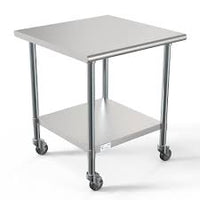
- Base typeA solid undershelf gives you storage you can sanitize. A wire shelf dries faster but traps grease where the wires cross. An open base lets bins roll under and the floor get cleaned properly. A cabinet base encloses storage and adds real weight.
- Legs and shelvesGalvanised costs less and is fine in dry areas. In dish, wet prep and cold rooms it corrodes from the bottom up — specify stainless throughout there.
- Feet or castersAdjustable bullet feet thread in and out to level the table on a floor that slopes, and they are the default. Casters make it mobile, but the legs have to be shortened to keep the working height right — so decide before it is built, not after.
- Length and supportPast about five feet a table wants six legs or reinforcement under the top; past eight feet it always does. A long table on four legs will deflect in the middle, and you will notice every time you lean on it.

Measure the doorway before you measure the wall
The most expensive mistake in custom fabrication is a piece that is perfect for the room and will not get into it. A welded table does not come apart.
Before anything is cut, measure the tightest point on the route in: the narrowest doorway, the turn at the top of the stairs, the lift car if there is one. Send us that number with your dimensions and we will design around it — or split the piece deliberately, in a place that makes sense.
What to send us
Every one of these changes the price or the drawing, so the more that arrive with the enquiry, the faster you get a real quote:
- Measured dimensionsLength, depth and working height, taken on site. Plan dimensions and site dimensions are rarely the same number.
- Height to matchWhether the top has to line up with equipment already installed either side.
- Gauge and gradeOr tell us what will sit on it and how hard it will be used, and we will recommend.
- Edge per side, backsplash per sideWhich sides face a wall, which face the room, which get wet.
- Base and feetUndershelf, open or cabinet; feet or casters.
- For sinksHow many bowls, which side the drainboard sits, and where the drain and supply lines already come up through the floor or wall.
- Cut-outsColumns, pipework, sockets — measured from a fixed corner.
- The route inThe tightest doorway or turn between the street and the room.
- A photo or sketchA phone photo of the space with a tape measure in it is worth more than a paragraph of description.
How the job runs
Send the measurements and photos to aabbas@a3trading.ca, or use the form at the bottom of this page. We quote the piece, and where the job needs it we issue a drawing for you to approve. Nothing is cut until the drawing and the quote are agreed — and once it is cut, the dimensions are the ones you signed off, so read them carefully.
Every fabrication job is priced individually, so ask about the timeline for your piece at the same time you ask about the cost. When it is finished you can collect it from the Surrey warehouse, or we can arrange delivery anywhere in Canada; delivery is quoted and charged separately and is never included in the price of the work.
If certification matters for your inspection — NSF/ANSI 2 covers materials, corners, welds and crevices being cleanable — raise it in your enquiry so it is written into the quote rather than assumed.
Where this sits in the rest of the job
Tables are usually the last thing to land in a fit-out, once the ventilation and the cladding are in and the equipment is placed. For the wider picture see kitchen design and installation; for the wall the table backs onto, stainless steel wall cladding; and for the hood above the line, commercial kitchen exhaust hoods. A broader overview of the shop’s work is on the custom stainless steel fabrication page.
You can see the whole thing done at scale in the Reflection Banquet Hall case study, where custom-fabricated bar stations went in alongside the hot line and the warewashing. If the fabrication is part of a larger fit-out, equipment financing is available.
Questions we get asked
Is custom much more expensive than a standard table?
Less than people expect — it is a premium over the nearest catalogue size, not a different order of magnitude. What genuinely moves the number is gauge, welded integration such as a built-in sink bowl, and how many separate pieces the job becomes. If a stock size fits, it will still be cheaper and faster, and we will say so.
Do you come and measure, or do I send dimensions?
Either can work, but the piece is cut to whatever numbers are agreed. If you are sending them yourself, measure on site rather than off the plan, and send a photo with the tape in shot.
14 or 16 gauge — what do I actually need?
16 for general prep and work surfaces. 14 where equipment sits on it, where it takes constant heavy loading, or where you know staff will treat it badly. And ask for the gauge of the shelf and legs, not just the top.
Which edge should I choose?
Wet work, marine edge. Against a wall, square edge so there is no gap. Island tables people work from both sides of, rolled edge. You can mix them on one table.
Can you build a sink into the table?
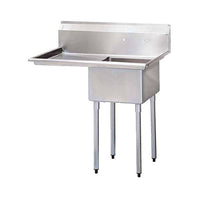
Yes, and it is one of the better reasons to go custom — one welded unit with no join between the table and the sink means one less crevice to clean. Send the bowl sizes you need and where the existing drains come up.
Can I have casters instead of feet?
Yes, but say so before it is built. Casters add height, so the legs have to be made shorter to keep the working surface where you want it. Retrofitting them afterwards leaves you with a table that is too tall.
Will it fit through my door?
Only if you tell us the door. Measure the narrowest point on the route in and send it with the dimensions — we will either design around it or split the piece somewhere sensible.
How long does it take?
Every piece is quoted individually, so ask about the timeline for yours at the same time as the price. The clock starts when the drawing and the quote are agreed, not when the enquiry arrives.
Do you deliver and install?
You can collect from the Surrey warehouse or we can arrange delivery anywhere in Canada. Delivery is quoted separately on every order. If the piece is part of a larger fit-out we are already installing, say so and we will scope it together.
Start a fabrication quote
Send the measured dimensions, the edge and base you want, and the tightest doorway on the way in. Use the form below, or reach us directly.
- Phone
- (778) 512-5098
- Toll-free
- +1 833-673-1893
- aabbas@a3trading.ca
- Warehouse and pickup
- 107 - 12332 Pattullo Pl
Surrey, BC V3V 8C3, Canada