Store Credit — 5% off your next order
Your first order is at regular price. Once that order is placed you earn 5% store credit on any product — the discount is applied automatically at checkout from your 2nd purchase onward. Just be signed in to the same account you ordered with.

Quick view 
Quick view 
Quick view 
Quick view 
Quick view 
Quick view 
Quick view 
Quick view 
Quick view 
Quick view 
Quick view 
Quick view 
Quick view 
Quick view 
Quick view 
Quick view


Hot Food Tables
Commercial Hot Food Tables for Buffets, Cafeterias and Serving Lines
A commercial hot food table, often called a steam table, is a serving unit with heated wells that hold cooked food at a safe serving temperature. It does not cook food. It keeps prepared dishes hot and ready during service, so the line can keep moving.
Restaurants, buffets, cafeterias, schools, hospitals, caterers and banquet halls use hot food tables to serve soups, sauces, proteins, rice, vegetables and sides from food pans. Most units include a stainless steel body, an undershelf for storage and, on many models, a sneeze guard.
A3 Equipment carries commercial hot food tables for kitchens and serving lines across Canada. This page explains how they work, how the main types differ and what to check before you order, so you can match a table to your menu, service style and kitchen layout.
How a Hot Food Table Works
A commercial hot food table holds already-cooked food at serving temperature using heated wells that each take a standard food pan. It is a holding appliance, not a cooking appliance, so food should be fully cooked and hot before it goes in.
Wet wells
Wet wells are filled with water. The heating element warms the water, and the hot water and steam heat the pans evenly. This gentle, moist heat suits sauces, soups, gravies, vegetables, rice and pasta, which can dry out or form a skin under direct heat.
Wet wells need water at the start of service, water top-ups during long service, and draining and cleaning afterwards.
Dry wells
Dry wells have no water. The heating element warms the well directly, and the pan sits in the heated cavity. Setup is faster, there is no water to refill or drain, and cleaning is simpler. Dry wells suit foods that do not need added moisture, such as breaded items, roasted proteins and baked dishes.
Filled pans hold heat better, so avoid running dry wells with empty or half-empty pans.
| Wet wells | Dry wells | |
|---|---|---|
| Heat | Hot water and steam | Direct heat from the element |
| Best for | Sauces, soups, vegetables, rice, pasta | Fried, roasted and baked items |
| Setup | Fill with water first | Ready quickly |
| During service | Water may need topping up | Nothing to refill |
| Cleaning | Drain and clean the wells | Simpler wipe-down |
| Moisture | Holds moisture in food | Does not add moisture |
Benefits of Commercial Hot Food Tables
- Steady serviceCooked dishes stay at serving temperature in the line, so staff can keep serving without going back to the range.
- Food safety supportHeated wells help keep food at or above the minimum hot-holding temperature of 60°C (140°F) when used correctly.
- Flexible menu layoutEach well takes a standard pan, so you can mix mains, sides and sauces in one line.
- Scalable sizingTables range from small two-well units to larger configurations for high-volume service.
- Good fit for catering and buffetsPortable and countertop options suit off-site events, while floor models suit permanent serving lines.
- Easy pan changesStandard pan sizes make it simple to swap in fresh batches during service.
Types of Commercial Hot Food Tables
Countertop hot food tables
Countertop units sit on an existing counter or prep table. They suit cafés, small restaurants and satellite serving points with limited floor space.
Floor-standing hot food tables
Floor models include a stainless steel body with an undershelf or cabinet base for storing pans, utensils and supplies. They suit cafeterias, buffets and catering kitchens that need more capacity.
Portable hot food tables
Portable models on casters move between a kitchen and a serving area, which suits banquet halls, events and offsite catering.
Well count and pan capacity. Hot food tables are sized by the number of full-size pans the top accepts. Common configurations range from two wells up to five or more. Confirm the well count and pan size on the product page, and check whether you can mix in smaller fractional pans.
Controls and features. Look at whether the table has one control for all wells or an independent control for each well. Individual controls let you hold different dishes at different settings. Other features include sneeze guards, cutting boards, tray slides, drain taps and undershelves.
Hot Food Tables at A3 Equipment
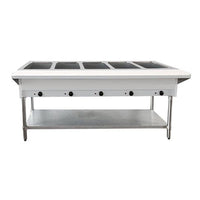
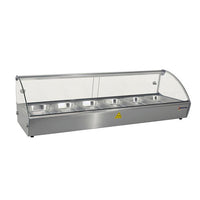
Four of the sixteen tables we stock, from a two-pan countertop unit to a five-pan electric line and a four-pan natural gas model. Most sizes are listed in electric, natural gas and propane.


How to Choose the Right Hot Food Table
The right hot food table depends on your menu, service style, number of dishes, available space and electrical supply. Work through these points before you compare models.
- Wet or dryChoose wet wells if your menu has sauces, soups, vegetables, rice or pasta. Choose dry wells if you want faster setup and simpler cleaning, and your menu is mostly fried, roasted or baked items. Some kitchens choose a model that can run either way.
- Number of wellsCount the dishes you need on the line at once, including mains, sides and sauces, then add room for growth. A larger table gives you more flexibility, but also needs more space and power.
- Pan size and depthCheck that the wells fit the pans you already use, including depth. Standard full-size pans are common, but confirm sizes before you buy.
- Electrical requirementsCheck the voltage, amperage and plug type, and confirm that your site can supply it, especially for larger tables. Ask your installer if you are unsure.
- Space and mobilityMeasure the footprint and the path to the serving area. Decide whether you need a countertop unit, a floor model or a portable table on casters.
- Controls and cleaningIndividual well controls give you more flexibility. Think about how your staff will clean the unit, and whether wet well draining suits your workflow.
- Food safety featuresCheck whether you need a sneeze guard or food shield for self-serve areas. Follow your local public health rules for hot-holding, thermometer checks and buffet service.
| Consideration | What to check |
|---|---|
| Wells | Wet or dry |
| Capacity | Number of wells and pan size |
| Power | Voltage, amperage and plug |
| Space | Footprint, countertop, floor or portable |
| Controls | Single or individual well control |
| Cleaning | Draining, access and wipe-down |
| Safety | Sneeze guard, temperature monitoring |
Not sure which table fits? Send A3 Equipment your menu, number of dishes and service style, and our team can help you compare options.

Why Buy Hot Food Tables from A3 Equipment?
A3 Equipment supplies commercial foodservice equipment to kitchens across Canada. Our team can help you compare hot food tables against your menu, service style, space and electrical supply, so you choose a table that fits how you serve.
You can also look at related equipment, such as food warmers, heated display cases and soup kettles, on the same site when you plan a full serving line.
Browse the hot food tables above, or contact A3 Equipment for help choosing a model.
Hot Food Table FAQs
What is a commercial hot food table?
A commercial hot food table is a heated serving unit that holds cooked food at serving temperature in wells that each take a food pan. It is used in buffets, cafeterias and catering to keep dishes hot during service.
What is the difference between wet and dry hot food tables?
Wet wells use heated water and steam, which keeps moisture in sauces and vegetables. Dry wells heat the pan directly with no water, so they set up faster and are easier to clean. Choose by menu and how much maintenance you want.
What temperature should a hot food table hold food at?
Food should be held at 60°C (140°F) or higher. Check food temperature with a thermometer, and follow your local public health guidance for how often to check and record it.
Can you reheat food in a hot food table?
No. Hot food tables hold food that is already hot and are not designed for heating cold food. Heat or cook food to the required temperature first, then move it to the table.
How many wells do I need?
Count the dishes you serve at once, including mains, sides and sauces, and add room to grow. Tables are commonly sold with two to five wells or more.
Do hot food tables need a water connection?
Wet wells are filled with water by hand or a faucet, and may have a drain. Dry wells need no water. Most tables run on electricity, so check the voltage and plug before ordering.
Can I use dry wells with water?
It depends on the model. Some tables are designed for wet use only or dry use only, while others can run either way. Check the product page and manufacturer instructions before adding water.
What size pans fit a hot food table?
Most use standard full-size food pans and accept fractional pans through adapter bars or inserts. Check the well dimensions and depth on the product page.
Not sure which hot food table fits your line?
Send us your menu, how many dishes you hold at once and the power you have at the serving area. We will come back with the well counts that fit and a delivery quote for your address.
- Phone
- (778) 512-5098
- Toll-free
- +1 833-673-1893
- Info@a3trading.ca
- Warehouse
- 107 12332 Pattullo Pl, Surrey, BC V3V 8C3