Store Credit — 5% off your next order
Your first order is at regular price. Once that order is placed you earn 5% store credit on any product — the discount is applied automatically at checkout from your 2nd purchase onward. Just be signed in to the same account you ordered with.

Quick view 
Quick view 
Quick view 
Quick view


Gyro Machines
Commercial Gyro Machines for Restaurants, Food Trucks and Takeout Counters
A commercial gyro machine is a vertical broiler that rotates a stack of meat on an upright spit in front of a heat source, so the outside cooks while staff slice thin portions to order. The same style of machine is also used for shawarma, doner kebab and tacos al pastor.
Gyro shops, Greek and Middle Eastern restaurants, kebab counters, taquerias, food trucks and takeout shops use gyro machines as the centrepiece of the menu. The rotating cone of meat sits in view of customers, so the machine cooks and merchandises at once.
A3 Equipment carries commercial gyro machines for operators across Canada. This page explains how they work, how the main types differ and what to check before you order, so you can match a vertical broiler to your menu, volume and kitchen setup.
What Is a Commercial Gyro Machine?
A commercial gyro machine is a vertical rotisserie broiler built to cook a stacked cone or column of meat on a rotating spit. Heat from gas burners or electric elements cooks the outer layer, and staff shave the cooked meat off in thin slices as orders come in.
How a gyro machine works
Meat is loaded onto a vertical spit, either as a prepared cone or as layers stacked by the operator. A motor turns the spit so all sides face the heat evenly, and burners or elements sit beside the meat. As the outer layer browns, the cook carves it off, and the lower layers keep cooking. A drip tray below catches fat and juices.
Gyro, shawarma and doner
Gyro, shawarma and doner are different dishes with different seasonings and styles, but they are cooked on the same kind of vertical broiler. Recipes, meat preparation and loading differ by menu, so choose a machine that handles your product and cone size.
Gas vs. electric gyro machines
Gas models use burners, usually infrared, and tend to give strong heat and fast browning. They need a gas supply and an installation that meets local code. Electric models use heating elements, are often simpler to hook up and give gentler heat. A gas unit still needs electricity for the rotating motor, and electric does not automatically mean a hood is not required. Always confirm ventilation requirements for your exact model and location.
Gyro machines vs. other equipment
A vertical broiler is built for rotating cones of meat. For rotating whole birds, see our rotisserie ovens. For other cooking on the line, see our commercial griddles and commercial ranges.
Benefits of Commercial Gyro Machines
- Cooks and displays at onceThe rotating cone draws customers in and supports impulse sales.
- Made-to-order slicingStaff carve fresh portions as orders arrive, which keeps the meat hot and moist.
- Even cookingContinuous rotation exposes every side to heat, giving a consistent browned surface.
- Good for busy countersOne machine can supply a steady flow of orders for gyros, wraps, plates and bowls.
- Flexible menu useThe same machine supports gyro, shawarma, doner and al pastor with the right meat preparation.
- Range of sizesSmaller units suit food trucks and light volume, and larger units suit high-traffic restaurants.
Types of Commercial Gyro Machines
Gas vertical broilers
Gas models use burners, often with separate controls, and suit kitchens with a gas supply and ventilation. Check the number of burners, the heat control and whether the unit runs on natural gas or propane.
Electric vertical broilers
Electric models use heating elements and plug into an electrical supply. They can suit sites without gas, but check the voltage, circuit capacity and ventilation requirements.
Countertop and floor models
Countertop models sit on a counter or stand and suit food trucks, cafés and small takeout counters. Floor-standing models are larger and suit busier restaurants. Check the footprint and the height needed to load and carve.
Burner count and heat zones
More burners generally mean more control over how the cone cooks from top to bottom. Separate burner controls help you manage the cooking zone as the cone shrinks. Check how the model lets you adjust the distance between meat and heat.
Capacity levels
Capacity is usually stated as the weight of the meat the spit can hold. Small units suit light volume and compact spaces, while large units hold well over 100 pounds for high-traffic service. Rated capacity is a maximum load, not an hourly output, so size to your busiest period rather than the maximum.
| Type | Typical use | Key consideration |
|---|---|---|
| Gas | Restaurants, kebab shops, high-volume counters | Gas supply, hood and installation |
| Electric | Sites without gas, smaller counters | Voltage, circuit and ventilation |
| Countertop | Food trucks, cafés, small counters | Space and spit height |
| Floor-standing | Busy restaurants and takeout | Footprint and delivery access |
| Multi-burner | Larger cones and heat control | Burner controls and distance adjustment |
Gyro Machines at A3 Equipment
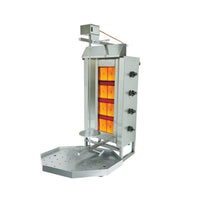
Four Omcan vertical broilers, in two cone sizes and both fuel types. If you need an electric unit or a different capacity, see our Autodoner gyro machines or ask us for a quote.


How to Choose the Right Commercial Gyro Machine
The right gyro machine depends on your menu, peak demand, utilities, ventilation and kitchen layout. Start with these points.
- Peak demandEstimate how many portions you sell in your busiest hour, then choose a machine whose cone capacity suits that volume. An oversized cone creates waste when demand is low, while an undersized one runs out mid-rush.
- Gas or electricCheck your available gas and electrical supply. Confirm the fuel type and requirements, and check whether the unit needs electricity for its motor.
- Burners and heat controlLook for adjustable burners or elements, and a way to change the distance between the meat and the heat. These controls help you cook the cone evenly as it shrinks.
- Spit and motorCheck that the spit is sturdy and secure, and that the motor rotates smoothly under load. Make sure the spit length and cone size match the meat you plan to use.
- Drip tray and grease managementCheck that the drip tray is removable and easy to clean. Good grease management keeps service cleaner and safer.
- Ventilation and fire safetyGas units typically need a hood, and electric units may also need ventilation depending on the model and local code. Have a qualified installer assess placement, ventilation and fire protection for your site.
- Workflow and placementAllow room to load, carve and assemble orders without crossing raw food areas. Many operators place the machine near the front counter where customers can see it.
- Food safetyFollow your meat supplier’s instructions, the manufacturer’s manual and your local food safety rules for cooking, slicing and hot holding. Do not judge doneness by the outside colour alone.
- CleaningAllow the unit to cool before cleaning. Remove drippings regularly, and keep water and cleaners away from burners, controls and the motor. Follow the manufacturer’s cleaning instructions.
| Consideration | What to check |
|---|---|
| Demand | Cone capacity vs. your peak hour |
| Fuel | Natural gas, propane or electric |
| Heat control | Burner count, separate controls, distance |
| Mechanics | Motor, spit and cone size |
| Grease | Removable drip tray |
| Ventilation | Hood and fire protection per local code |
| Workflow | Loading, carving and assembly space |
| Cleaning | Cooling, drip tray and safe cleaning |
Not sure which gyro machine fits your kitchen? Send A3 Equipment your menu, expected volume and kitchen details, and our team can help you compare options.

Why Buy Gyro Machines from A3 Equipment?
A3 Equipment supplies commercial foodservice equipment to kitchens, counters and food truck operators across Canada. Our team can help you compare gyro machines against your menu, volume, ventilation and utilities, so you choose a model that fits how you cook and sell.
You can also look at related equipment, such as rotisserie ovens, griddles, hot food tables and heated display cases, on the same site when you plan a full kitchen or counter.
Browse the gyro machines above, or contact A3 Equipment for help choosing a model.
Commercial Gyro Machine FAQs
What is a commercial gyro machine?
A commercial gyro machine is a vertical broiler that rotates a stack of meat on an upright spit beside a heat source. The outer layer cooks while staff slice thin portions to order, which suits gyro, shawarma and doner menus.
What is the difference between a gyro machine, a shawarma machine and a vertical broiler?
They often describe the same type of equipment: a vertical rotating spit with a heat source. The names reflect the dish, such as gyro or shawarma, but recipes, meat preparation and loading differ.
Gas or electric: which gyro machine is better?
Neither is better for every kitchen. Gas models give strong heat and fast browning but need a gas supply and ventilation. Electric models are often simpler to install, but still need ventilation depending on the model and local code.
How much meat does a gyro machine hold?
It depends on the model. Small units hold a modest amount for light use, and large units hold well over 100 pounds. Rated capacity is a maximum load, so size to your busiest period.
Do gyro machines need a hood?
Gas units typically need a hood. Electric units may also need ventilation depending on the model and local code. Confirm the requirements with your installer and local authority before you install.
Does a gas gyro machine need electricity?
Yes. A gas unit still needs electricity to turn the spit motor, so check both the gas and electrical requirements before ordering.
How do you clean a gyro machine?
Let the machine cool, then remove drippings and clean the drip tray, spit and racks following the manufacturer’s instructions. Keep water and cleaners away from burners, controls and the motor.
What can you cook on a vertical broiler besides gyro?
Vertical broilers also cook shawarma, doner kebab and al pastor. Check the model and the manufacturer’s guidance for the meats and cone sizes it supports.
Not sure which cone size you need?
Tell us how many portions you sell at peak, what fuel you have and whether the machine sits on a counter or the floor. We will quote the vertical broiler that fits, including sizes we do not list online.
- Phone
- (778) 512-5098
- Toll-free
- +1 833-673-1893
- Info@a3trading.ca
- Warehouse
- 107 12332 Pattullo Pl, Surrey, BC V3V 8C3