
Wall Cladding
Painted drywall behind a fryer lasts about a season
Stainless cladding cut to your walls, fabricated and installed by A3 Fabrication Solutions — the same division that builds the tables and the hoods.
Where cladding earns its place — and where it does not
Most suppliers will happily clad your entire kitchen in stainless. We would rather tell you where it actually pays.
Stainless is the right answer behind the cook line, where heat, grease and daily degreasing destroy anything else, and around wash-up, where the wall is wet several hours a day and gets hit with caustic cleaners. Those two zones are worth doing properly and doing once.
Away from heat and constant water — dry storage, staff corridors, the back of a prep room — a hygienic PVC or FRP panel does the same hygiene job for a fraction of the cost. Cladding an entire kitchen in stainless is a real way to spend money that would be better in your cooking line. If a quote you have been given claddes every wall in 304, ask why.
304 or 430
This is the decision that matters most, and the one most quotes are vague about.
| 304 | 430 | |
|---|---|---|
| Contains nickel | Yes | No |
| Magnetic | No (a magnet will not stick) | Yes — the quick way to tell them apart |
| Handles | Wet, salty, acidic, chemically cleaned surfaces | Dry-ish wall protection |
| Fails where | Rarely, in a kitchen | Near dishwashers, brine, citrus and bleach — it pits and spots |
| Cost | Higher | Noticeably lower |
The sensible spec is zone by zone: 304 at the cook line and anywhere near wash-up, 430 acceptable for general wall protection in drier areas if the budget is tight. If someone has quoted 430 behind your dish machine, that is where the spotting will start.
Thickness and finish
| Gauge | Roughly | Use |
|---|---|---|
| 24 ga | 0.6 mm | Light splashbacks and small panels. On a long flat run it can ripple. |
| 22 ga | 0.75 mm | A middle ground for general wall protection. |
| 20 ga | 0.9 mm | The usual choice for full-height cladding that has to stay flat and take knocks. |
Thinner sheet is cheaper, and on a large unbroken wall it shows — it “oil cans”, meaning it takes on visible ripples between fixings. If the wall is long and in view, go heavier.
On finish, No. 4 brushed is the kitchen standard: a directional satin grain that hides fingerprints and light scratching. 2B mill finish is flatter, cheaper and marks more easily — perfectly reasonable behind equipment where nobody is looking at the wall. Mirror finishes belong front of house, not in a kitchen.

The joints are what fail, not the steel
Stainless does not wear out. What fails an inspection is the gap: an unsealed seam between two sheets, an open edge at the floor, exposed screw heads collecting grease, a corner where two panels meet with a shadow line behind them.
That is why cladding is a system rather than a stack of sheets — H-section joints, internal and external corner profiles, top and end caps, a coved detail at the floor junction, and food-grade neutral-cure silicone in every seam. When we quote a wall, the trims are in the quote.
How it compares to the alternatives
| Surface | Cleanability | Life | Near heat |
|---|---|---|---|
| Stainless | Best — non-porous, survives harsh cleaners | Dents but does not degrade | Non-combustible. The only sensible answer at the cook line. |
| FRP / GRP panel | Good, though the texture holds a grease film | Can crack and delaminate over time | Combustible — keep it away from the line |
| Hygienic PVC sheet | Very good, and joints can be welded seamless | Scuffs; softens near heat | Combustible — keep it away from the line |
| Tile | The grout is the weak point — porous and it stains | Grout fails long before the tile does | Non-combustible |
| Epoxy paint | Fine when new; chips become traps | Needs recoating | Depends entirely on the substrate |
What inspection is looking for
Under the BC food premises rules, plans for a new or altered food premises are reviewed by a health officer, and the submission has to state what the floors, walls and ceilings are finished in. What the guidance asks for is a wall surface that is smooth, non-absorbent, washable and light in colour, with the floor-to-wall junction sealed. Bare or painted drywall in a cooking or prep area does not meet that.
Note what that does not say: no rule names stainless steel. Stainless, FRP and commercial tile are all commonly accepted. Stainless is expected at the cook line for a different reason — the fire side. Clearance is required between cooking appliances and combustible construction, and a noncombustible surface is the normal way of dealing with a wall that is too close.
Confirm the detail with your inspector before you order. Requirements differ between health authorities and municipalities, and they change. We will tell you what we understand for your project, and we will cut to whatever your inspector signs off — but their answer is the one that governs, not ours.
What to send us
- Wall measurementsLength and height of each wall to be clad, measured on site rather than taken off the plan. Note anything that is visibly out of square.
- What is behind itDrywall, tile, block or plywood — and whether the surface is flat and sound. This decides whether panels can be bonded or need mechanical fixing.
- Every penetrationOutlets, switches, gas lines, shelf brackets, taps, thermostat — with dimensions from a fixed corner. Every hole is cut before the sheet leaves the shop.
- What sits against the wallThe equipment either side, and how tall it is, so the panel heights make sense.
- Full height or splashbackWhether you want floor to ceiling, or a panel behind a specific appliance.
- PhotosA phone photo of each wall with a tape measure held against it tells us more than a paragraph.
Where this sits in the rest of the job
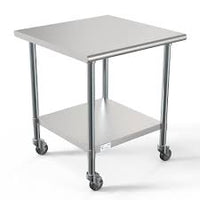
Cladding usually goes in during a fit-out, after the ventilation is set and before the equipment is placed — the sequence covered on our kitchen design and installation page. The wall behind the line and the exhaust hood above it are usually specified together, and the work tables that sit against the clad wall come out of the same shop.
For one-off pieces rather than whole walls, see custom stainless steel fabrication. If you are local, the Surrey page covers pickup and how the warehouse works.
Questions we get asked
Do I need 304, or is 430 good enough?
304 anywhere it will be wet or chemically cleaned — the cook line and wash-up. 430 is acceptable for general wall protection in drier areas and will save you money there. Tell us the zones and we will price them separately rather than quoting one grade for the whole room.
Can you fit it over my existing tile or drywall?
Usually. What matters is whether the surface is flat, sound and dry. A flat wall takes bonded panels; an uneven one needs mechanical fixing, which changes the trim detail. Send photos and we will tell you which you are looking at.
What does it cost per square foot?
It depends on grade, gauge, how many cut-outs there are, how much trim the walls need and whether we are installing. We will not quote a number here that turns out to be wrong for your room. Send the measurements and you will get a real one.
Do I need full-height panels or just a splashback?
Behind a fryer or a charbroiler, full height is the safer call — heat and grease travel further up the wall than people expect. A splashback is reasonable behind a single low appliance in a cooler part of the kitchen.
Can you cut the holes for my outlets and gas lines?
Yes, and it is much better done in the shop than on site. Send the positions measured from a fixed corner, not from another outlet.
Will it rust? My old stainless has spots on it.
Spotting is usually one of three things: it is actually 430 in a wet zone, it has been cleaned with something chlorine-based, or steel dust from another trade has settled on it and rusted there. Proper 304, cleaned with the right products, does not spot.
How do I clean it without scratching it?
Wipe along the grain, not across it. Hot water and a mild detergent for daily work, a dedicated stainless cleaner when it needs more. Avoid steel wool, abrasive pads and anything containing chlorine bleach.
How long will my kitchen be shut?
It depends on the wall area, how much cutting is involved and whether equipment has to be moved out. Ask us when you send the measurements — we would rather give you a realistic window for your job than a number that suits the brochure.
Can you match my existing hood and equipment?
Send a photo. Matching the grain direction and finish of what is already installed is straightforward if we know what it is.
Start a cladding quote
Send the wall measurements, what is behind them and where every outlet and pipe comes through. Use the form below, or reach us directly.
- Phone
- (778) 512-5098
- Toll-free
- +1 833-673-1893
- aabbas@a3trading.ca
- Warehouse and pickup
- 107 - 12332 Pattullo Pl
Surrey, BC V3V 8C3, Canada